Beyond Static Embeds: How to Convert PDF Documents into Clean, Responsive HTML
Learn how to convert PDF to HTML without messy code. Discover how to turn fixed documents into clean, responsive, and searchable web pages free.
Publishing content online should be seamless, yet millions of websites still rely on embedded PDF files to display reports, brochures, user manuals, and digital catalogs. While PDFs preserve print formatting perfectly, embedding a fixed-layout document into a modern website creates major friction. Mobile visitors are forced to pinch and zoom across rigid pages, search engine crawlers struggle to index deep text nodes, and web analytics tools fail to track reader engagement.
Learning how to convert pdf to html solves this problem by unlocking static text and vector graphics into clean, semantic markup. Instead of trapping your readers inside a heavy document viewer, transforming document files into HTML lets you build fully responsive web pages that scale beautifully across mobile devices, load instantly, and rank naturally on search engines.
In this guide, you will learn how to turn fixed PDF documents into clean, web-ready HTML code. We will cover the core technical conflicts of vector-to-DOM rendering, explain how to extract clean CSS and structural code from multi-page documents, and troubleshoot common conversion bugs—like overlapping text boxes, missing fonts, and messy inline styles.
Looking for a fast, browser-based workflow to transform your files? Just as you can convert document pages into high-resolution images using our
What is a PDF to HTML Converter and How Does It Work?
What is a PDF to HTML converter?
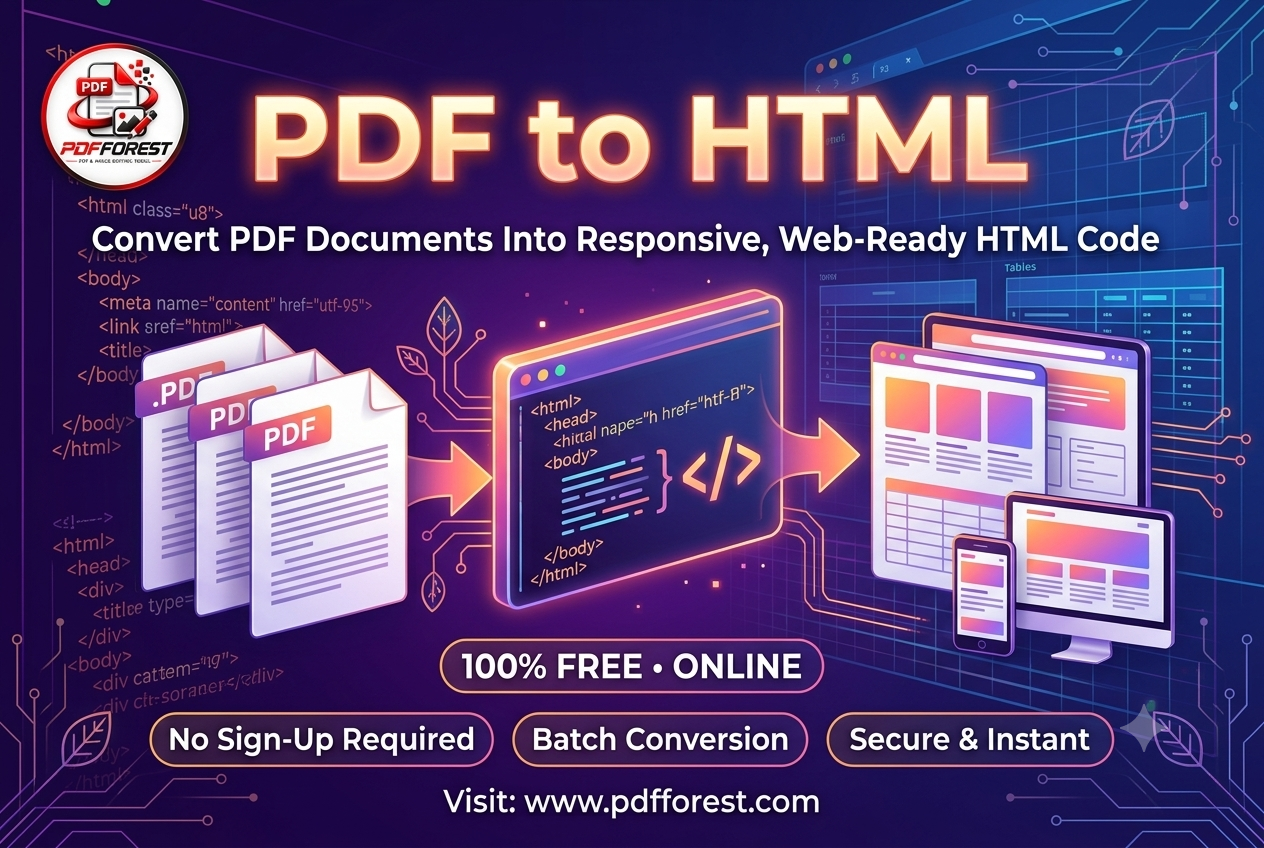
A PDF to HTML converter is a developer utility that parses static Portable Document Format files (.pdf) and translates their text, images, and visual vectors into structured HyperText Markup Language (.html) and Cascading Style Sheets (.css). The tool reconstructs the document's visual layout into semantic code, making the content searchable, editable, and responsive on modern web browsers.
At its core, a pdf to html converter transforms fixed visual coordinates into a dynamic web page through a four-stage conversion pipeline:
Spatial Parsing: The engine scans the PDF to locate text blocks, images, vector paths, and metadata, mapping out their spatial coordinates on the fixed canvas.
DOM Reconstruction: It translates raw text fragments into logical DOM (Document Object Model) elements—mapping large bold text to heading tags (
,), paragraph clusters totags, and visual grids intostructures.
Asset Extraction: Images and custom vector graphics embedded inside the PDF are extracted, optimized, and saved as web-standard formats (
.jpg,.png, or.svg).CSS Generation: The converter generates a clean stylesheet, using CSS Flexbox or absolute positioning to preserve visual alignment while enabling smooth web browser rendering.
Whether you need to use a batch convert pdf to html online free tool for bulk document publishing or rely on an instant pdf to html code generator browser based utility for quick code edits, this pipeline saves you from rewriting code by hand.
The Core Technical Conflict: Fixed Layout Vectors vs. Dynamic Web Flow
Why do raw conversions often result in messy code? The fundamental challenge when you turn pdf into html lies in the completely different ways PDFs and web browsers render visual information.
Absolute Position Coordinates vs. Responsive DOM Flow
PDFs were created for print stability. Every word, letter, and line sits on an absolute coordinate plane ($X, Y$ axis) anchored to fixed page dimensions (like A4 or US Letter). If a paragraph wraps across three lines in a PDF, the file does not store it as a unified paragraph block; it stores three independent text strings positioned at specific vertical coordinates.
In contrast, web browsers rely on dynamic DOM flow. Elements stack fluidly, resizing automatically based on the user's screen width. Converting an absolute coordinate PDF directly into HTML without structural parsing often results in thousands of unmaintainable
tags with hardcodedtop: 142px; left: 88px;styles, destroying mobile responsiveness.HTML<div style="position:absolute; top:120px; left:45px;">Structured Datadiv> <div style="position:absolute; top:135px; left:45px;">In an XML file...div> <article class="content-block"> <h2>Structured Datah2> <p>In an XML file...p> article>To convert pdf layout to html flexbox code successfully, your converter engine must analyze visual grouping, interpret white space, and reconstruct raw coordinate strings into a modern, fluid layout framework.
Step-by-Step: How to Convert PDF to Responsive HTML Without Losing Formatting
Generating clean, production-ready web code from complex documents takes less than two minutes using modern web utilities.
1. Prepare and Validate Your Source PDF
Before converting, inspect your document. Make sure the text inside your PDF is selectable and not an image-only scan. If you are working with scanned paper documents, run them through an OCR (Optical Character Recognition) tool first to convert scanned images into readable text strings.
2. Select a Web-Based PDF to HTML Engine
Open a free online pdf to html converter no signup directly in your mobile or desktop browser.
Drag and drop your
.pdfdocument into the processing panel.If you have dozens of documents—such as quarterly reports or product sheets—use a tool that supports batch operations to batch convert pdf to html online free.
3. Configure Code Output Settings
Select output options based on how you plan to use the web content:
Semantic Web Page (Recommended): Reconstructs text into structured HTML tags (
,,Exact Visual Match: Uses precise CSS positioning to mirror complex brochure or flyer layouts, ensuring pixel-perfect visual fidelity.
4. Generate, Preview, and Export Code
Click Convert. The engine parses the data, extracts embedded images, and builds a package containing your
.htmlfile, linked.cssstylesheets, and an image asset folder. Download the archive or copy the generated code directly into your content management system (CMS).Troubleshooting Guide: Fixing Common PDF-to-HTML Code Errors
When you convert pdf to web page formats, structural mismatches can occasionally produce styling or layout bugs. Here is how to fix the most common issues:
1. Text Lines Overlap or Wrap Awkwardly on Mobile Screens
The Cause: The converting engine used fixed absolute pixel widths (
width: 800px;) instead of flexible percentage or viewport units.The Fix: Open the generated stylesheet and replace hardcoded container widths with
max-width: 100%;andheight: auto;. Reframe main content blocks usingdisplay: flex;ordisplay: grid;to allow fluid reflow across mobile breakpoints.
2. Complex Tables Render as Broken Divs
The Cause: The parser failed to recognize cell borders and column alignments, converting a structured dataset into isolated floating text boxes.
The Fix: Use a specialized converter mode designed to convert pdf invoice to semantic html table structures. This forces the engine to reconstruct grid coordinates into proper
,
,, and markup. 3. Missing Custom Fonts and Unreadable Symbols
The Cause: The source PDF used non-standard embedded fonts that are not installed on the user's web browser, or missing character maps led to encoding errors.
The Fix: Ensure your converter exports embedded fonts as web-friendly
@font-faceformats (.woff2) or maps legacy font styles to standard web-safe font stacks (such as Arial, Helvetica, or system sans-serif). Ensure the HTML file header contains a validdeclaration.
Strategic Value of Web-Native PDF Content
Enhancing Web Accessibility (WCAG Compliance)
Fixed document embeds frequently fail Web Content Accessibility Guidelines (WCAG) because screen readers struggle to parse hardcoded coordinate text. Converting documents into semantic HTML ensures screen readers can read heading structures, interpret image
altattributes, and navigate table data naturally.Unlocking Search Engine Indexing and Organic SEO
Search engine bots are designed to crawl and index structured HTML markup. While search engines can read PDF text, they struggle to assign context to unstyled document content. Converting static whitepapers and manuals into indexable web pages lets you optimize titles, meta descriptions, and internal linking structures, turning locked content into a continuous source of organic search traffic.
Frequently Asked Questions (FAQs)
How do I convert a PDF file to HTML without losing formatting?
To convert pdf to responsive html without losing formatting, use an advanced converter like PDFFOREST. The tool analyzes visual document boundaries, extracts graphics, and reconstructs coordinate layout blocks into responsive CSS Flexbox containers, preserving your layout while making it mobile-friendly.
Can I convert PDF documents into web code on my smartphone?
Yes. You can use a convert pdf to html code on mobile free utility directly inside any mobile browser. Simply upload your document from your cloud storage or files app, generate the code, and download the web files instantly without installing third-party apps.
Will converting a PDF to HTML make its text searchable on Google?
Yes. Unlike embedded document viewers that hide text inside opaque canvas frames, converting document content into standard HTML markup exposes clean text, headings, and image alt tags to search engine crawlers, allowing your content to be fully indexed and ranked on search results.
Transforming static document archives into clean, responsive web pages does not require hours of manual coding or expensive web design software. By pairing intelligent DOM parsing with web-based converter tools to turn pdf into html, you can clean up messy code, build responsive layouts, and publish web-ready content in seconds.
Whether you need to publish digital catalogs, make corporate reports searchable, or streamline your frontend development workflow, visit
PDFFOREST.com to explore our full suite of fast, secure, and free digital document and web utilities.Related Articles
View All
Effortlessly convert any document to PDF and image with our versatile PDF-to-All Converter. This tool supports various formats, ensuring seamless transitions for all your files. Whether you need to convert text, images, or spreadsheets, our converter delivers high-quality results quickly and efficiently. Simplify your document management today!
Policy Pages